CLIP, OpenCLIP, SigLIP and SigLIP 2
An interactive field guide
Follow two encoders into one similarity matrix, then separate the changes in loss, data and training.
Before this article: ViT · Semantic representations
What was already possible
Section titled “What was already possible”Natural language changes the supervision interface
Section titled “Natural language changes the supervision interface”A fixed classifier has one learned weight vector for each training class. CLIP instead learns an image encoder and a text encoder from paired images and descriptions. It can later encode a new list of class descriptions as classifier weights. Earlier work already connected language and images; CLIP combines a simple contrastive objective with broad paired data and model scaling. Its image encoder can be a modified ResNet or a ViT. The ViT branch is the main drawing here, not a claim that every CLIP model is a ViT.
What changes, and why
Section titled “What changes, and why”Read from left to right. Select a module to connect its role, tensor shape, and calculation. Snippets are teaching pseudocode. Sources provide the paper method or audited implementation.
Natural language changes the supervision interface
A fixed classifier has one learned weight vector for each training class. CLIP instead learns an image encoder and a text encoder from paired images and descriptions. It can later encode a new list of class descriptions as classifier weights. Earlier work already connected language and images; CLIP combines a simple contrastive objective with broad paired data and model scaling. Its image encoder can be a modified ResNet or a ViT. The ViT branch is the main drawing here, not a claim that every CLIP model is a ViT.
# Teaching pseudocode; not a complete training implementation.
images, captions = paired_batch()
image_features = image_encoder(images)
text_features = text_encoder(captions)
Training state: Training and inference roles are separated below.
Step-by-step explanation: Natural language changes the supervision interface
Two towers meet in a shared embedding space
The image tower pools an image feature, then projects it to dimension d. The text tower tokenizes a description, applies a causal Transformer, selects its end-of-text representation and projects to the same d. Normalize both vectors to unit length. Their dot product is then cosine similarity. Shared output dimension does not mean shared encoder weights. Original CLIP uses a learned positive logit scale. It has no cross-attention between image patches and words in this dual-encoder path.
# Teaching pseudocode; not a complete training implementation.
U = l2_normalize(image_projection(image_features))
V = l2_normalize(text_projection(eos_features))
S = exp(logit_scale) * U @ V.T
Training state: Training and inference roles are separated below.
Step-by-step explanation: Two towers meet in a shared embedding space
A batch becomes B×B matching questions
Arrange B paired images and texts in the same order. Row i compares image i with every text; column j compares text j with every image. Diagonal entries are the paired positives. Image-to-text cross-entropy normalizes each row; text-to-image cross-entropy normalizes each column. Average both directions. Increasing one negative score changes the softmax probabilities of other entries in that row or column. Unpaired entries are treated as negatives even when their content is actually compatible, so noisy and repeated captions matter.
# Teaching pseudocode; not a complete training implementation.
labels = arange(batch_size)
row_loss = cross_entropy(S, labels)
column_loss = cross_entropy(S.T, labels)
loss = (row_loss + column_loss) / 2
Training state: Training and inference roles are separated below.
Step-by-step explanation: A batch becomes B×B matching questions
Zero-shot classification reuses the text tower
Write a prompt for each candidate class, such as “a photo of a dog”. Encode and normalize each prompt. These text vectors form the columns of a classifier. Compare a new image vector with all candidates and choose the largest score. The resulting probability depends on the supplied candidate list, prompt wording and scale; it is not an unconditional probability that the world contains that class. Prompt ensembling averages normalized descriptions for a class and normalizes the resulting class vector. No image decoder or autoregressive text generator is required for this decision.
# Teaching pseudocode; not a complete training implementation.
class_vectors = encode_and_normalize(class_prompts)
image_vector = encode_and_normalize(image)
prediction = argmax(image_vector @ class_vectors.T)
Training state: Training and inference roles are separated below.
Step-by-step explanation: Zero-shot classification reuses the text tower
Two towers meet in a shared embedding space
Section titled “Two towers meet in a shared embedding space”The image tower pools an image feature, then projects it to dimension d. The text tower tokenizes a description, applies a causal Transformer, selects its end-of-text representation and projects to the same d. Normalize both vectors to unit length. Their dot product is then cosine similarity. Shared output dimension does not mean shared encoder weights. Original CLIP uses a learned positive logit scale. It has no cross-attention between image patches and words in this dual-encoder path.
CLIP: separate image and text towers, one paired similarity objective
Section titled “CLIP: separate image and text towers, one paired similarity objective”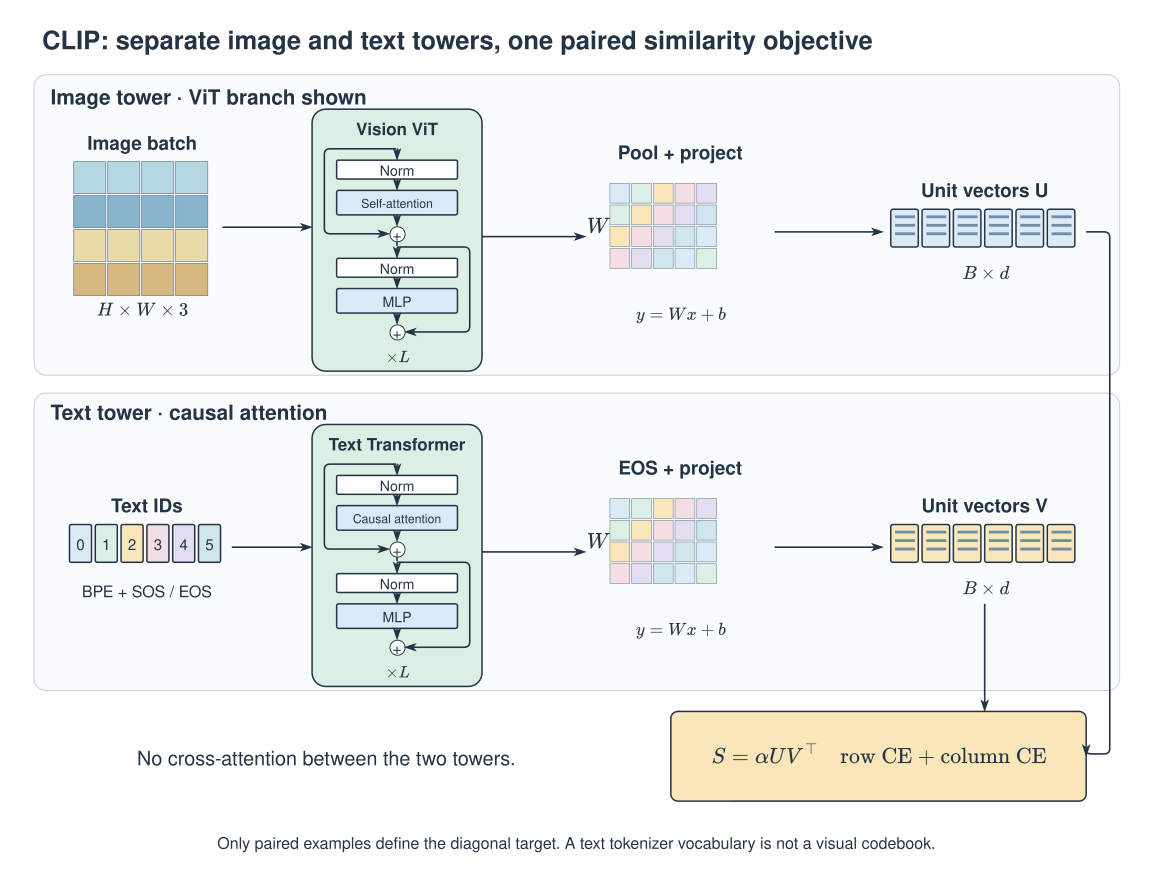
Work through the mechanism
Section titled “Work through the mechanism”Read the architecture and the equations together. Each version changes a specific part of the learning system.
A batch becomes B×B matching questions
Section titled “A batch becomes B×B matching questions”Arrange B paired images and texts in the same order. Row i compares image i with every text; column j compares text j with every image. Diagonal entries are the paired positives. Image-to-text cross-entropy normalizes each row; text-to-image cross-entropy normalizes each column. Average both directions. Increasing one negative score changes the softmax probabilities of other entries in that row or column. Unpaired entries are treated as negatives even when their content is actually compatible, so noisy and repeated captions matter.
OpenCLIP makes the training ecosystem inspectable
Section titled “OpenCLIP makes the training ecosystem inspectable”OpenCLIP is an open implementation, training toolkit and collection of checkpoints. It is not a single new loss that replaces CLIP. The reproducible scaling study varies model size, LAION data scale and the number of samples seen while retaining the contrastive objective. Dataset size and samples seen are different quantities because training can revisit examples. Report the architecture and training-data tag together: a ViT-L/14 name alone does not identify one embedding distribution or one set of weights.
SigLIP replaces the batch normalization in the objective
Section titled “SigLIP replaces the batch normalization in the objective”SigLIP treats every image–text pair as a binary classification example. Let yij be +1 on the diagonal and −1 elsewhere. A learned scale and bias produce the logit. The loss applies log-sigmoid independently to each labeled pair, without row or column softmax denominators. It still uses negative pairs, and processing all pairs still has quadratic pair count. The original paper divides the summed pair loss by B, not B². Its pairwise structure permits chunked computation without a global softmax normalizer; it does not remove shared-parameter coupling between pairs.
CLIP-related methods: separate the ecosystem from the objective
Section titled “CLIP-related methods: separate the ecosystem from the objective”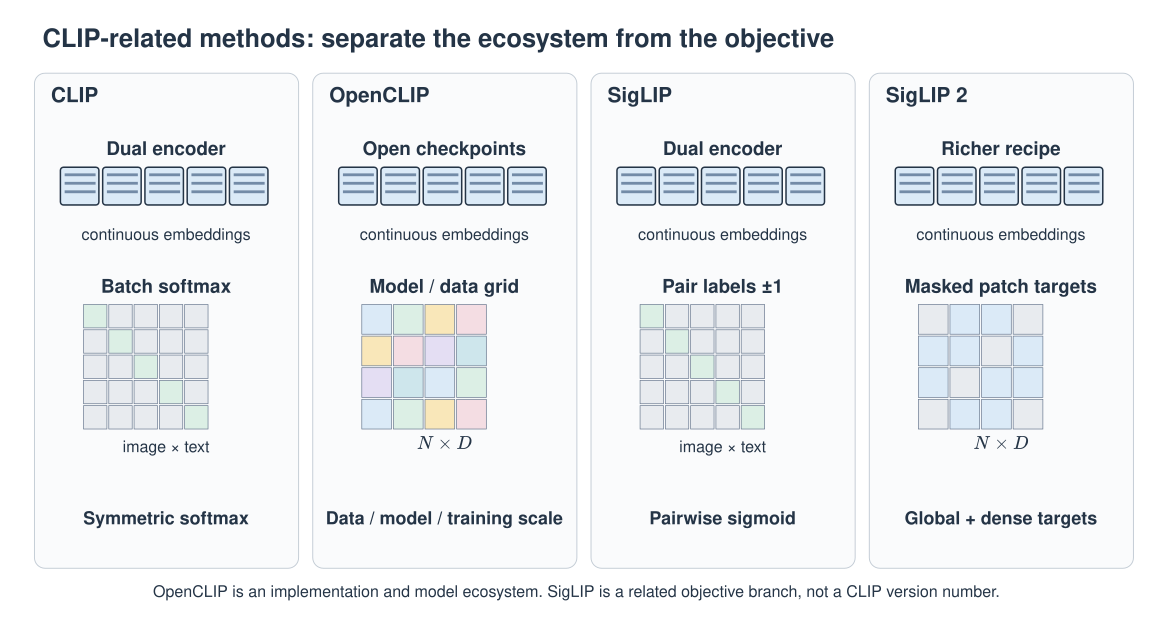
Same pair scores: softmax competition or binary logistic losses
Section titled “Same pair scores: softmax competition or binary logistic losses”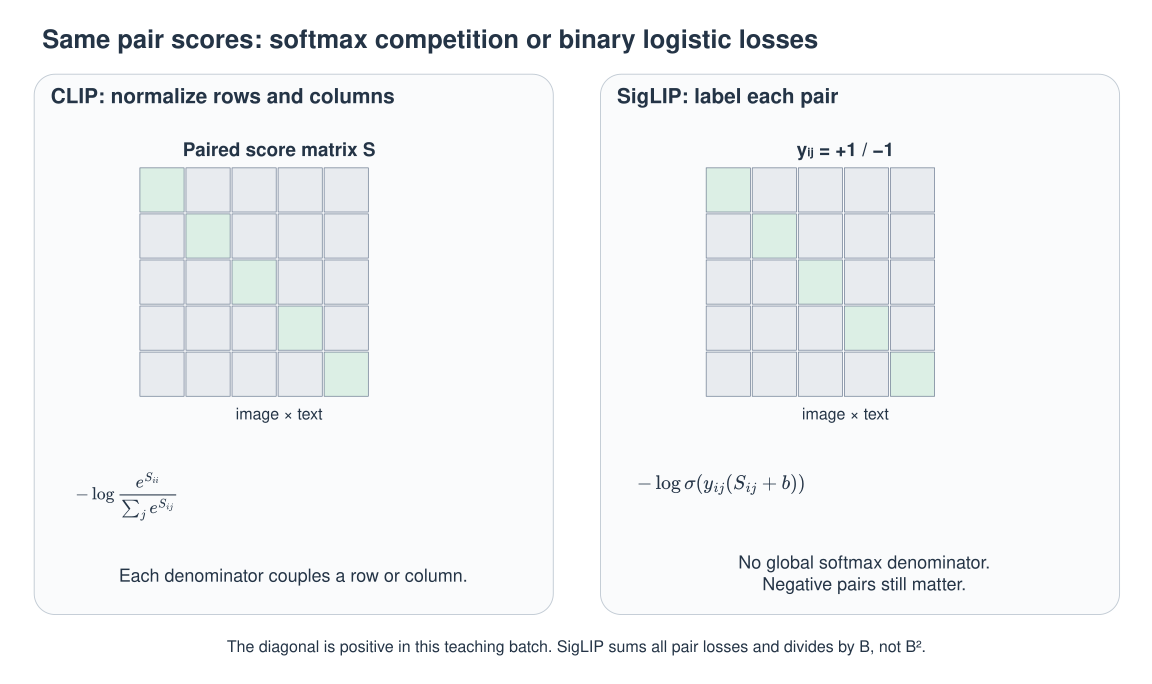
One similarity matrix, two objectives
Fixed teaching vectors. We compute probabilities and losses, not training stability or model quality.
Image unit-vector angles: 0°, 75°, 150°. Text angles: 10°, 65°, 160°. Switch between similarities and probabilities; rows are images and columns are texts.
| Image / text | 0 | 1 | 2 |
|---|---|---|---|
| 0 | 0.9432 | 0.0567 | 0.0001 |
| 1 | 0.0561 | 0.9334 | 0.0105 |
| 2 | 0.0002 | 0.0111 | 0.9887 |
I→T: · T→I:
CLIP: · SigLIP:
SigLIP divides the summed pair loss by batch size B, as in the paper, not B². Loss scales differ; a smaller number does not identify a better model.
Training is not sampling
Section titled “Training is not sampling”Zero-shot classification reuses the text tower
Section titled “Zero-shot classification reuses the text tower”Write a prompt for each candidate class, such as “a photo of a dog”. Encode and normalize each prompt. These text vectors form the columns of a classifier. Compare a new image vector with all candidates and choose the largest score. The resulting probability depends on the supplied candidate list, prompt wording and scale; it is not an unconditional probability that the world contains that class. Prompt ensembling averages normalized descriptions for a class and normalizes the resulting class vector. No image decoder or autoregressive text generator is required for this decision.
SigLIP 2 improves both global and local features
Section titled “SigLIP 2 improves both global and local features”SigLIP 2 combines sigmoid image–text training with a training-only decoder for captioning and localization, then adds self-distillation and masked patch prediction. The released vision encoder is not that caption decoder. Pooled vectors support image–text matching; unpooled patch features support dense tasks and visual-language connectors. Fixed-resolution variants and NaFlex are different recipes. NaFlex preserves aspect ratio approximately, adds patch coordinates and padding masks, and supports several sequence lengths. Its adaptation stage omits the self-distillation and masked-prediction losses to manage cost.
What this does not establish
Section titled “What this does not establish”What a VLM takes from a CLIP-family encoder
Section titled “What a VLM takes from a CLIP-family encoder”A multimodal language model often takes patch features before global pooling, then changes their width or spatial count with a connector. The learned text vocabulary belongs to a text tokenizer; it is not a codebook for those visual vectors. Qwen3-VL continues training a SigLIP-2-initialized vision tower, so its final representation is not identical to the original contrastive checkpoint. For reconstruction, an RAE decoder must learn to map the selected features back to pixels. Alignment quality alone does not guarantee that all small text, geometry or texture survives.
Check your understanding
Section titled “Check your understanding”Are these features discrete reconstruction codes?
No. The backbone emits continuous features. Prediction prototypes or text IDs do not make them a VQ codebook. Reconstruction requires a separately specified decoder and training objective.
Sources and next steps
Section titled “Sources and next steps”- CLIP and SigLIP series · 2103.00020v1
- Method / pinned implementation source
- RAE
- Qwen3-VL: from patches to DeepStack
Original teaching diagrams and snippets are identified separately from attributed paper figures. Paper reports, implementation observations, and analytical examples are distinguished. No research model runs in this page.