Gemma 4: encoders, pooling and an encoder-free branch
An interactive field guide
Compare five variants without hiding the 12B architecture behind a family name.
Before this article: Visual tokenizers in multimodal models
What was already possible
Section titled “What was already possible”One family, three visual configurations
Section titled “One family, three visual configurations”E2B and E4B use a roughly 150M vision encoder with 16 blocks and width 768. The 31B and 26B-A4B variants use a roughly 550M encoder with 27 blocks and width 1152. The 12B variant removes the separate vision Transformer. Treating all five as one visual tokenizer would hide the main architectural difference.
The text vocabulary has about 262K entries. That is a text-tokenizer property, not the number of visual codes. Likewise, quantization-aware training for compact weights does not imply that image representations use a discrete VQ codebook.
What changes, and why
Section titled “What changes, and why”Read from left to right. Select a module to connect its role, tensor shape, and calculation. Snippets are teaching pseudocode. Sources provide the paper method or audited implementation.
Encode small patches before spatial averaging
The encoder variants use 16×16 RGB patches. A learned projection and two-dimensional absolute positions feed bidirectional visual Transformer blocks with axial 2D rotary positions. After image-wide processing, groups of 3×3 spatial features are averaged, normalized/scaled and projected to the language width.
z = vision_transformer(patches16, positions_xy)
z = spatial_average_pool(z, kernel=3)
valid_z = remove_padding(z, valid_mask)
visual = language_projection(valid_z)
Training state: Static source inspection; training state is discussed below.
Step-by-step explanation: Encode small patches before spatial averaging
A token budget is an upper bound, not an exact count
The supported image budgets are 70, 140, 280, 560 and 1120 soft tokens. Set the pooled spatial unit m=16×3=48 pixels. The ideal target area is budget×48². Scale both original sides by the square root of target area divided by original area, then round each down to a multiple of 48.
H2, W2 = aspect_ratio_resize(H, W, max_soft_tokens=B)
patch_count = (H2 // 16) * (W2 // 16)
valid_soft_tokens = patch_count // 9
Training state: Static source inspection; training state is discussed below.
Step-by-step explanation: A token budget is an upper bound, not an exact count
12B projects larger pixel blocks without a vision tower
The 12B model takes 48×48×3=6912 values per pixel block and uses a lightweight embedding path. Its configuration still lists processor patch_size=16 and pooling_kernel_size=3, but model_patch_size=48. The processor repacks 3×3 small pixel patches into a larger block. Repacking pixels is not averaging encoded features.
raw48 = repack_pixel_patches(raw16, group_side=3)
z = ln2(dense(ln1(raw48)))
z = ln3(z + position_x + position_y)
visual = multimodal_projection(rms_norm(z))
Training state: Static source inspection; training state is discussed below.
Step-by-step explanation: 12B projects larger pixel blocks without a vision tower
Encode small patches before spatial averaging
Section titled “Encode small patches before spatial averaging”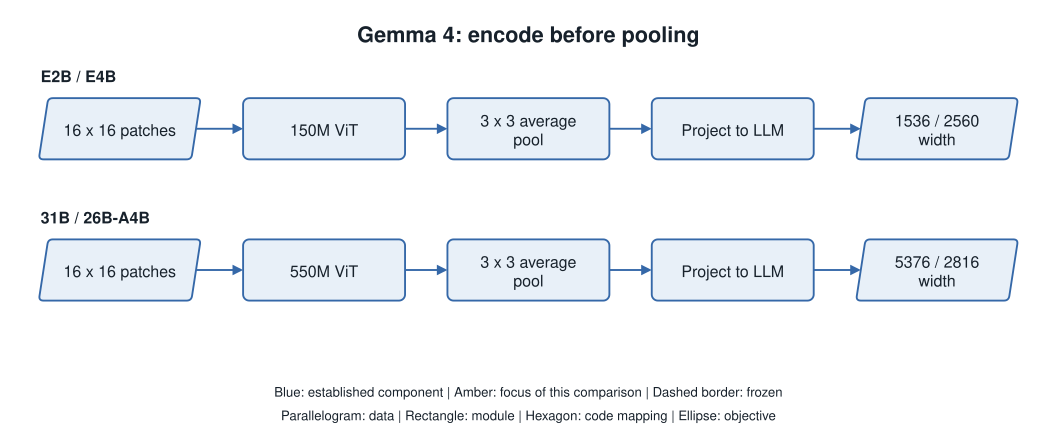
The encoder variants use 16×16 RGB patches. A learned projection and two-dimensional absolute positions feed bidirectional visual Transformer blocks with axial 2D rotary positions. After image-wide processing, groups of 3×3 spatial features are averaged, normalized/scaled and projected to the language width.
Pooling reduces nine feature positions to one after the visual tower has already exchanged information. It is not equivalent to averaging raw pixels before the encoder. The LLM widths are variant-specific: 1536 for E2B, 2560 for E4B, 5376 for 31B and 2816 for 26B-A4B.
z = vision_transformer(patches16, positions_xy)
z = spatial_average_pool(z, kernel=3)
valid_z = remove_padding(z, valid_mask)
visual = language_projection(valid_z)12B projects larger pixel blocks without a vision tower
Section titled “12B projects larger pixel blocks without a vision tower”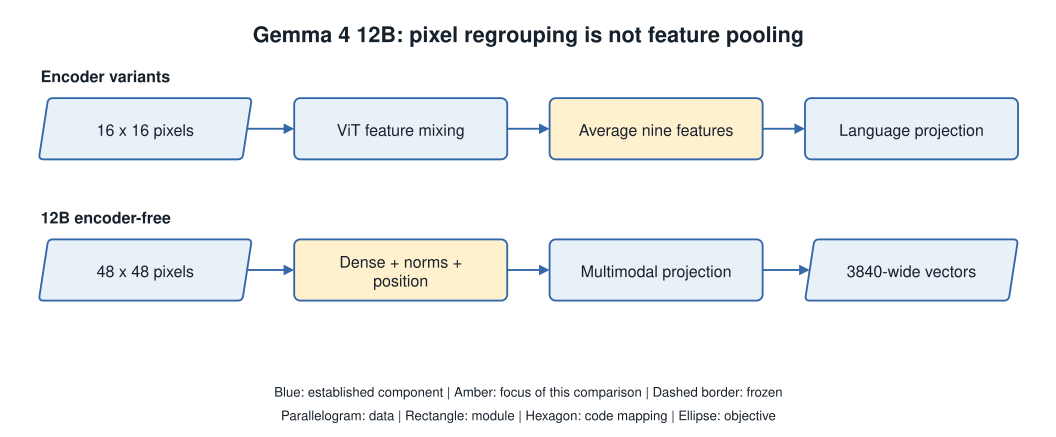
The 12B model takes 48×48×3=6912 values per pixel block and uses a lightweight embedding path. Its configuration still lists processor patch_size=16 and pooling_kernel_size=3, but model_patch_size=48. The processor repacks 3×3 small pixel patches into a larger block. Repacking pixels is not averaging encoded features.
The inspected implementation applies LayerNorm, a dense projection, LayerNorm, factorized x/y position embeddings, another LayerNorm, then an RMSNorm and a multimodal projection. The output width is 3840. The report’s “single large matmul” describes the main visual projection; the full interface includes these additional operations.
raw48 = repack_pixel_patches(raw16, group_side=3)
z = ln2(dense(ln1(raw48)))
z = ln3(z + position_x + position_y)
visual = multimodal_projection(rms_norm(z))- Pinned encoder-free implementation — Gemma4UnifiedVisionEmbedder
Work through the mechanism
Section titled “Work through the mechanism”A token budget is an upper bound, not an exact count
Section titled “A token budget is an upper bound, not an exact count”The supported image budgets are 70, 140, 280, 560 and 1120 soft tokens. Set the pooled spatial unit m=16×3=48 pixels. The ideal target area is budget×48². Scale both original sides by the square root of target area divided by original area, then round each down to a multiple of 48.
Integer grids can change the aspect ratio slightly and leave part of the budget unused. In report Figure 2, a 572×1024 image (width×height) with an illustrative budget of 10 becomes 96×192: 72 small patches and eight soft tokens. Ten illustrates the algorithm; it is not an accepted budget in the public processor. The code also handles extremely narrow inputs when a rounded side would become zero.
H2, W2 = aspect_ratio_resize(H, W, max_soft_tokens=B)
patch_count = (H2 // 16) * (W2 // 16)
valid_soft_tokens = patch_count // 9Original figure: the budget need not be filled
Section titled “Original figure: the budget need not be filled”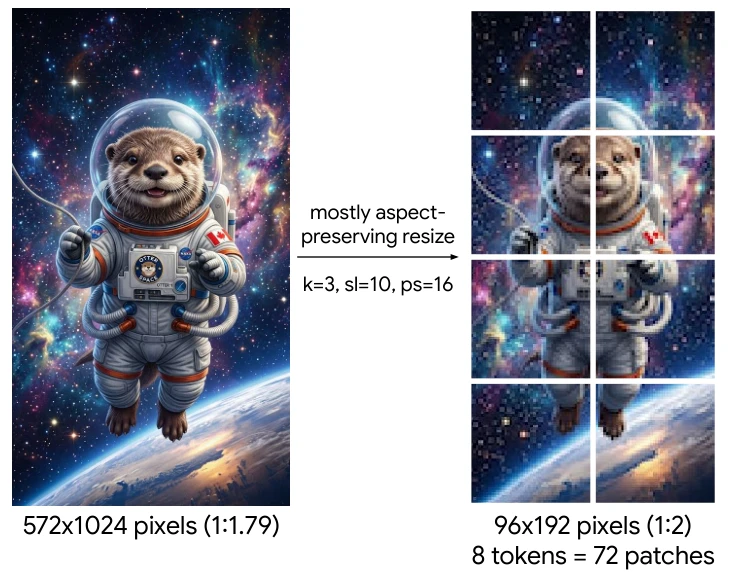
The figure uses a budget of 10 to illustrate rounding. The interactive model presets use only the public supported image budgets.
Trace pixels to visual tokens
Shape arithmetic, without model inference. Image mode follows the pinned resize rules. Here a Qwen budget sets the pixel-area limit corresponding to a maximum visual-token count; it is not a billing estimate.
| Stage / quantity | Result |
|---|---|
| Resized height | 768 |
| Resized width | 768 |
| Temporal groups | 1 |
| Repeated frames | 0 |
| Model patch-grid rows | 48 |
| Model patch-grid columns | 48 |
| Processor spatial units × time groups | 2304 |
| Model patch positions | 2304 |
| Effective visual tokens | 256 |
| LLM visual feature shape | [256, 5376] |
| Continuous scalar values | 1376256 |
16×16 patches → ViT → 3×3 average pool → LLM
27 vision blocks · width 1152 → 5376
Input: visual embeddings occupy image positions; text embeddings remain.
Pinned configuration for this variant
Effective tokens exclude padding slots, image boundaries, newlines, timestamp text and other text. Video mode does not sample frames or allocate video budgets: frame sides must be multiples of 32 for Qwen or 48 for Gemma. Repeating a still image satisfies the temporal patch interface; it adds no motion information.
Inspected checkpoint configurations
Checked: 2026-11-03. Each row links to a pinned version. Matching dimensions do not imply matching weights. The 12B patch column denotes the pixel block received by the model.
| Variant | Model patch | Vision blocks / width | Spatial operation | LLM width | DeepStack zero-based blocks |
|---|---|---|---|---|---|
| gemma-4-E2B-it | 16×16 | 16 / 768 | 3×3 average | 1536 | — |
| gemma-4-E4B-it | 16×16 | 16 / 768 | 3×3 average | 2560 | — |
| gemma-4-12B-it | 48×48 | 0 / 3840 | Pixel projection | 3840 | — |
| gemma-4-31B-it | 16×16 | 27 / 1152 | 3×3 average | 5376 | — |
| gemma-4-26B-A4B-it | 16×16 | 27 / 1152 | 3×3 average | 2816 | — |
“—” means no DeepStack injection in the inspected path, not an absence of visual information. All branches pass continuous vectors; text vocabulary sizes are not treated as visual codebooks.
Training and inference
Section titled “Training and inference”Compare pathways under their own training conditions
Section titled “Compare pathways under their own training conditions”The report states that the separate vision encoders are frozen during pretraining, while the encoder-free 12B model is trained from scratch. The public inference class does not by itself enforce the historical optimizer schedule. A reproduction needs explicit parameter groups and the matching training recipe.
A 48-pixel output unit appears in both routes. In one, small patches interact in a pretrained tower before pooling; in the other, the language backbone must process directly projected larger blocks. Equal output counts do not mean equal visual computation or equal detail retention.
What this does not establish
Section titled “What this does not establish”What remains unknown or outside this comparison
Section titled “What remains unknown or outside this comparison”The inspected report does not justify naming one exact SigLIP initialization checkpoint for every encoder variant. We preserve this uncertainty. The comparison concerns visual input and text output, not an image decoder. Audio and multi-token prediction are outside this page’s audit.
For reconstruction research, distinguish pre-pooling patch features, pooled features and the encoder-free projected blocks. They have different training histories and spatial interfaces. Training a new pixel decoder on any one of them is a separate experiment.
Check your understanding
Section titled “Check your understanding”Does processor patch_size=16 prove that Gemma 4 12B has a patch-16 vision Transformer?
No. The processor repacks pixels into 48×48 blocks; the model uses a projection path without that vision tower.
Sources and next steps
Section titled “Sources and next steps”- Gemma 4: encoders, pooling and an encoder-free branch · 2607.02770v2
- Method / pinned implementation source
Original teaching diagrams and snippets are identified separately from attributed paper figures. Paper reports, implementation observations, and analytical examples are distinguished. No research model runs in this page.